


In 1984, now-legendary director Hayao Miyazaki released a film that set a precedent of quality for his work, and greatly impacted the future of it. Nausicaä of the Valley of the Wind may not be the most iconic or popular film of his, and it’s not even the first, but it created the gold standard for what a Studio Ghibli film should live up to.
After Miyazaki’s feature directorial debut, Lupin III: The Castle of Cagliostro (an entry in the long-running Lupin III franchise), he went on to write and illustrate his own manga, Nausicaä of the Valley of the Wind, in 1982. The manga ran for a whopping 12 years total, but only a short couple of years into it, Miyazaki adapted the story into the feature film of the same name. The film’s success resulted in the founding of Studio Ghibli by Hayao Miyazaki, Isao Takahata, and Toshio Suzuki the following year.
But what stands out so much in Nausicaä of the Valley of the Wind that made it such a success? What are the core themes that Miyazaki set in place, that can be found in the DNA of the rest of his filmography?
‘Nausicaä of the Valley of the Wind’ Was Ahead Of Its Time

To put things succinctly, the film follows Nausicaä, the princess of the Valley of the Wind – one of the few surviving kingdoms in a distant post-apocalyptic age that is plagued with the threat of a toxic jungle and its insect inhabitants defiling the land.
When you think of a princess in an animated movie in this time period, of course, you couldn’t be blamed for thinking of Disney’s array of popular princess films. But Nausicaä was released in the middle of a 30-year Disney princess lull. The early ones, of course, had much more of a “damsel in distress” story. The later ones during the resurgence going into the ‘90s beheld a much more feminist perspective – one where the princess is fighting for her freedom or equality. While Nausicaä isn’t a Disney film, the point I’m trying to make is this: For an animated princess film, it not only brought about those ideals of independence before Disney made it there, but it actually focused on a princess who didn’t have to face those systemic struggles or oppression to begin with. Nausicaä is already a fully independent, free-spirited, empowered young woman, gliding through the winds of life with courage and confidence.
Threats Abounding

So instead, what does she face? The grave inevitabilities of death, destruction, and decay. Her father lays bedridden and weak from the poisons of the toxic jungle. Her people are caught in the crosshairs of a power struggle by the other remaining kingdoms. And her paradisiacal Valley of the Wind is under environmental threat from the jungle and it’s inhabitants.
While I claimed Nausicaä doesn’t face social struggles, there’s actually one small way she appears to in the midst of the threats she stands against. She always seems to shock and surprise Lord Yupa and other men of the Valley with her decision-making. This would seem to point to at least a small level of preconceived doubt about her in their heads. Perhaps they view her as having less intellect because of her age? Or because of her gender? But to these questions I have to say… It actually has nothing to do with her identity or status. It’s actually that she has a power that no other character in the film possesses.
Nausicaä’s Power
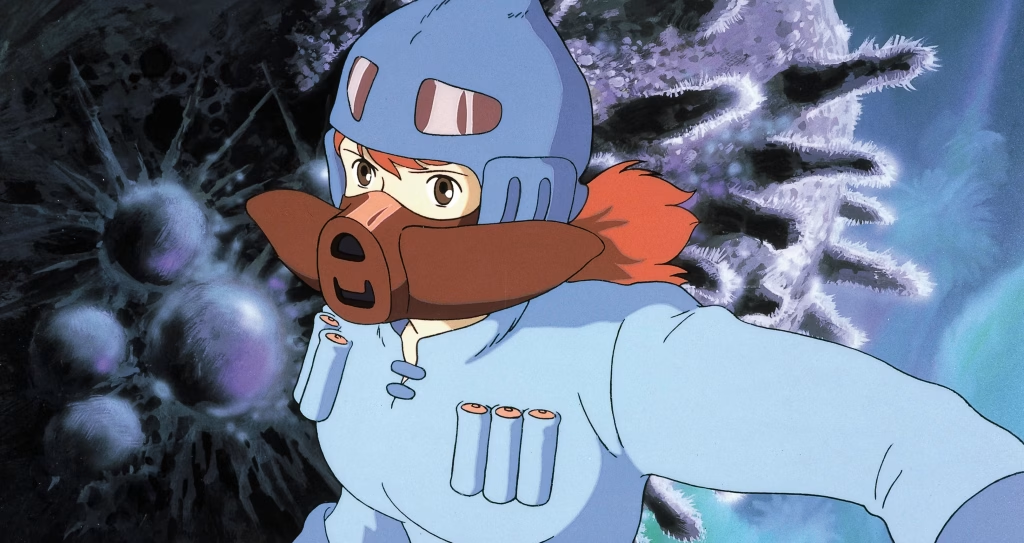
Toward the beginning of the film, Nausicaä is reminded of an age-old prophecy when Obaba points toward a tapestry and says, “There is a figure in the upper left corner. After 1,000 years of darkness, he will come clad in blue and surrounded by fields of gold to restore mankind’s connection with the Earth that was destroyed.” Later on, with a horde of the massive bugs known as Ohms stampeding toward the Valley, Nausicaä makes a choice – and not one that everyone would. She chooses to save the baby Ohm that the Tolmekian soldiers were using to lure the horde, rather than resort to violence. She keeps it from walking into a lake of acid, and then returns it to the rage-filled Ohms, but she’s badly hurt in the process of her selfless act.
The fulfillment of the prophecy then occurs when, not a man, but Nausicaä, with her dress tinged blue by the blood of the baby Ohm, is surrounded by a field of gold – that field actually being a beautiful display of the Ohms holding her up with their golden tendrils, healing her. By saving the baby Ohm, she restored mankind’s connection with the Earth by bringing about peace between the species. How did she do that? What power did Nausicaä possess that made her the chosen one the prophecy foretold of? Radical empathy.
Radical Empathy

That’s right… Nausicaä doesn’t possess any sort of mental or physical superpower, but rather, an emotional one. One that anyone has the ability to possess: empathy. From the very beginning she exhibits it. When she first holds Teto the Fox Squirrel, she senses his apprehension and attempts to calm him, saying, “There’s nothing to fear.” She’s constantly looking for ways to improve the lives of others in the Valley, whether that be her father, the king, or the lowly farmers. She’s always thinking of others and their needs.
But it goes further than that; Nausicaä holds what I call radical empathy. It’s the concept of empathy taken to its furthest extreme. She not only wants to understand the feelings and needs of those around her, but also of those in her furthest periphery. She’s not afraid to empathize with and show love to those who aren’t like her – even the insects of the jungle that everyone else fears. Nausicaä is willing to sacrifice her blood, sweat, and tears, for those who most are unwilling to understand. Yes, she’s the chosen one, but unity was really only found because she chose the lives of others over her own.
Nausicaä’s radical empathy is what truly cements her as an animated princess to be honored, and a cinematic hero to be celebrated. What Miyazaki ingrained in her can be found overflowing through the rest of his filmography, and it ought to be seen by all. Because in a world torn by discrimination and war, we need more inspiration for radical empathy. When we choose to put ourselves into the shoes of others and show them love – especially those different from us – it can go a long way.
Nausicaä of the Valley of the Wind is available to stream on HBO Max.
