


The Nintendo Switch 2 is finally here – the long-anticipated follow-up to the third-best-selling console of all time. Fans have waited years for a true successor to the original hybrid system, and now that it’s landed, the big question is: was it worth the wait?
If you’ve spent any time online lately, you’ll know the Nintendo Switch 2 has sparked plenty of debate — mainly around its steep price and limited exclusives, which we’ll get into. What we won’t be covering here are the Nintendo Switch Pro 2 controller (I haven’t got my hands on one yet) or the computer mouse mode.
A Brief History of the Nintendo Switch 2

If you’re new to the world of Nintendo, or just need a quick refresher, the original Nintendo Switch launched back in 2017 and quickly became iconic for its unique ability to “switch” between handheld and docked TV mode. What initially seemed like a gimmick proved to be one of the console’s greatest strengths – offering players the freedom to game on the go or kick back on the big screen, all with a smooth, near-instant transition.
By simply sliding the Joy-Cons in or out and docking or undocking the console, you could move between modes in seconds. That core hybrid functionality is still very much alive in the Nintendo Switch 2, and in many ways, it’s a testament to Nintendo’s “if it ain’t broke” philosophy. The design and mechanics feel instantly familiar to long-time players, making the Switch 2 a seamless upgrade with virtually no learning curve if you’re coming from the original. It builds on what worked before while gently refining the overall experience – and that’s no bad thing.
Nintendo Switch 2 Tech Specs and Display Changes
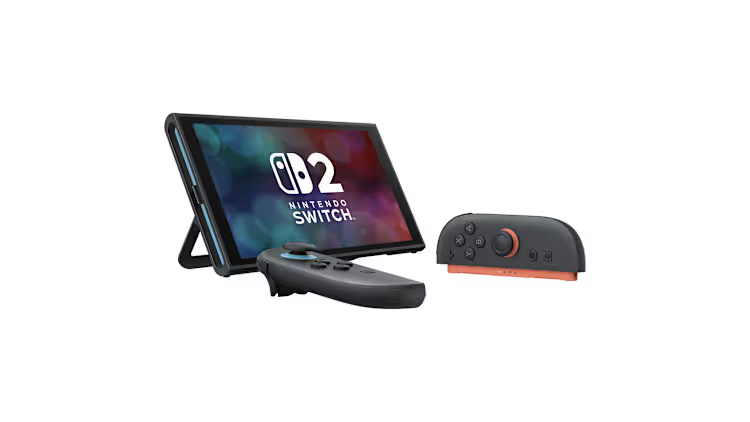
I’m not a massive tech guy, so if you want to know about RAM and memory, you’ll have to search elsewhere. I recommend the IGN Comparison Chart from which I got the dimensions and weight of the mainline Nintendo Switch consoles.
Right off the bat, you’ll see the obvious: the screen and console are larger, and at 7.9″ it’s the largest screen in the Nintendo Switch family, beating both the original Switch (6.2″) and the Switch OLED (7″). On paper, it doesn’t sound like a massive difference, but the difference is there! While it’s a back-to-basics LCD screen instead of an OLED (which I’m sure is on the way), the upgrade of the console makes up for it with its sharper image, which makes the games, especially ports like Legend of Zelda, pop more than they do on the OG Switch. Still, the lack of an OLED screen means that this half-portable console is mostly shite outdoors.
The console may be black and lacking in colour until you disconnect the Joy-Cons, but it has a nice matte finish that is mostly fingerprint-resistant, so you won’t see many smears or prints across the device. The console also has a less plastic, “toy-like” feel. But one of my biggest gripes with the old console carries over: it feels flimsy. Unfortunately, not much can be done because this flimsiness comes from the detachable Joy-Cons. The magnets by which they detach are stronger and sturdier than the predecessors, but it still feels like you could snap them off if you’re not careful. Drift is a major issue plaguing the original Switch — I wasn’t immune, having gone through at least two or three — but at the time of writing, I’ve experienced no issues with drift on either Joy-Con.

The Switch 2 weighs 0.88 lbs with both Joy-Cons attached, but it maintains the same 55″ thickness as the OG and OLED Switch. It’s heavier than them but lighter than a Steam Deck. Now, this is where my personal issue comes into play, but the weight combined with the thickness meant prolonged playtimes did hurt my wrists, especially after extremely sweaty knockout races in Mario Kart World. But as I said, this is an individual case, though it would be interesting if others have the same issue.
The battery is noticeably worse, though this depends on the game — you’ll get around 2–6 hours on it. Mario Kart World will get you about 2–3 hours, but an even more demanding game like Cyberpunk 2077 will eat it in about an hour and a half.
The UI is most disappointing because it’s almost exactly the same as the original UI, with only new additions to the bottom menu, albeit with the most satisfying sounds once pressed. And along with the UI disappointment comes the themes. We’re still stuck with the standard white and black. No fun Animal Crossing, Cyberpunk 2077 or Super Mario themes.
And also: still no trophies or achievements. Individual games may have their own, but the lack of achievements seems like another (albeit minuscule) step back.
Is the Nintendo Switch 2 a True Sequel or Just a Pro Upgrade?

My Popped colleagues disagreed with me when I said that the Nintendo Switch 2 was basically just that mythical Switch Pro. They’ll be pleased to know that more playtime has changed my opinion. This is very much a Nintendo Switch 2, not a Nintendo Switch Pro.
It turns out that your first exposure to the power of the Switch 2 isn’t best done with a first-party Switch 2 game, because Mario Kart World may be demanding for the console, but the classic cartoonish Nintendo style doesn’t allow for a good comparison with the predecessor. This is where third-party and ports come into play, and it’s no surprise that they’ve been pushing games like Cyberpunk 2077, Hogwarts Legacy and the Switch 2-versions of Legend of Zelda: Breath of the Wild, Tears of the Kingdom, and even Animal Crossing: New Horizons, which has no specific Nintendo Switch 2 port, but has its loading times cut down by a few seconds and has smoother transitions to the next worlds/rooms.
The console isn’t on the level of current-generation consoles like the PlayStation 5, sitting comfortably in the range of a PlayStation 4. That doesn’t mean that the console isn’t good – no, this upgrade is noticeable, needed, and necessary.
Nintendo Switch 2 Games, Exclusives, and Launch Price

At the start of the review, I mentioned the prices and the lack of Nintendo Switch 2 exclusives as a hot-button issue online. There are only 16 exclusives, including Nintendo Switch 2: Welcome Tour, which, in true Nintendo fashion, must be bought — despite being a “welcome tour.”
While there are 16 exclusives, the only one you’ll really hear about is Mario Kart World, the current flagship Nintendo Switch 2 game, as well as the Nintendo Switch 2 versions of the critically acclaimed Switch Zelda titles. It’s a shame that it’s lacking in games, because the prices for the console and the games are too high. In the UK, the console will set you back at least £395 with Mario Kart World bundled, and some games on their own cost upwards of £70, although certain games will come with an upgrade to the Nintendo Switch 2 version at a heavily discounted price.
The Nintendo Switch 2 is a strong addition to the Switch family line-up, with meaningful upgrades and clear potential. But right now, the high price point and lack of must-have exclusives make it a tougher sell than it should be. If you’re already a die-hard Nintendo fan, you’ll likely still find plenty to love — but for everyone else, the smarter move might be to wait. Give it a year, let the library grow, and hopefully pick it up at a more reasonable price.
